
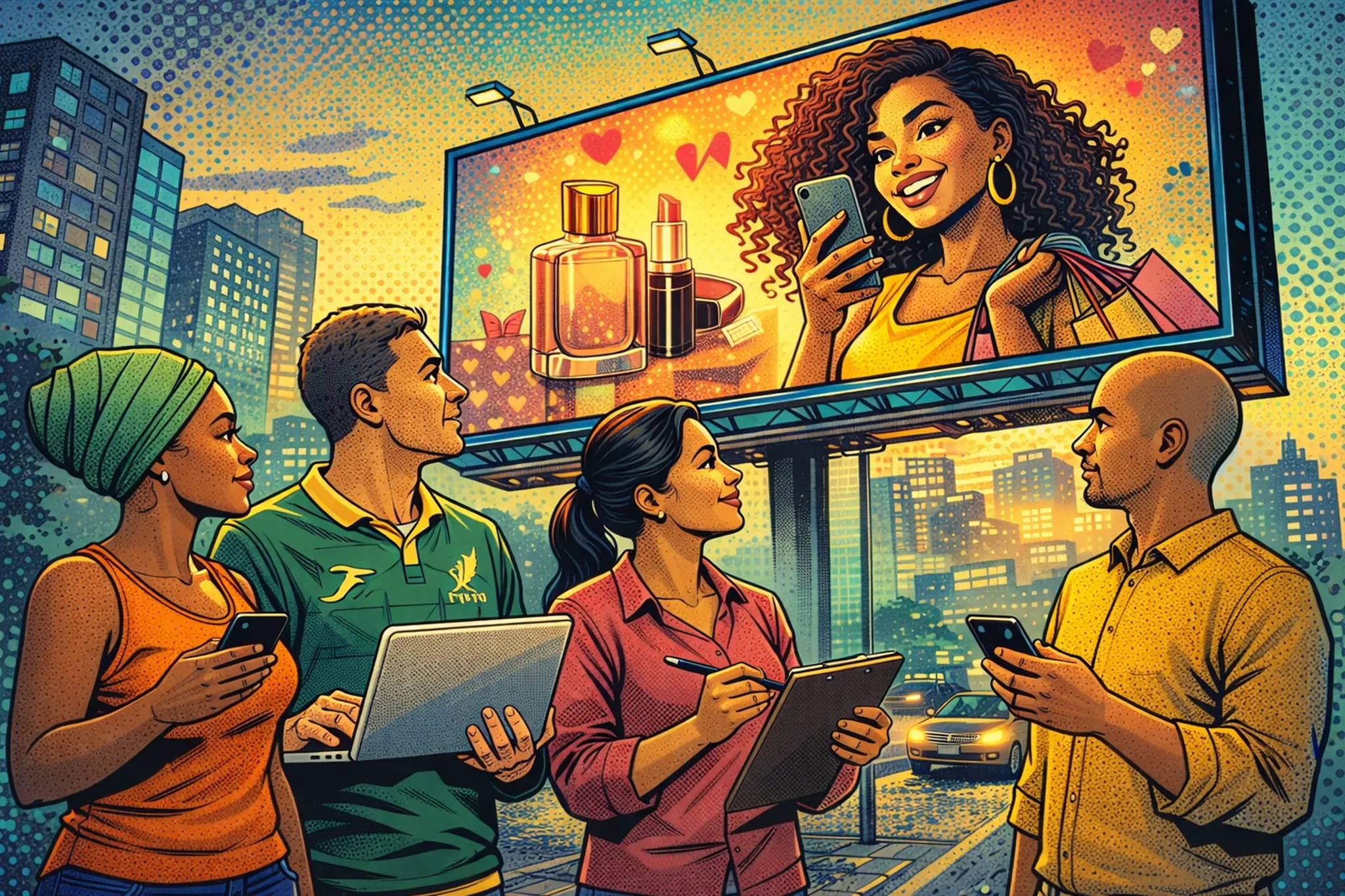
For those of us who’ve been wandering the media landscape for many seasons, it’s fair to say that the primary stat driving sales is always ‘reach’: aka ‘how many’. Whether it’s circulation, viewership, listenership or, in the case of OOH, traffic counts and footfall, we’re an industry that’s obsessed with potential eyeballs, and for good reason. After all, it’s hard to buy, or sell, mysterious media.
So make no mistake, these are important metrics. ‘How many’ validates reach. It underpins rate cards. It enables planning models. It gives media owners and buyers a common trading currency.
What it doesn’t do is deliver a ‘double click’:
- Who are those people?
- What shapes their decisions?
- What actually resonates with them?
- And critically - what do they notice and respond to?
These are the questions we’re constantly asked in an ever-evolving, increasingly crowded media world in which marketing budgets are under scrutiny and creative effectiveness is under pressure. In that world, quality of audience is becoming increasingly important and that’s where BrandMapp enters stage left.
Expanding the Lens: Adding Substance to Scale
BrandMapp can never replace traditional OOH metrics – but it can certainly enrich them. Traffic tells you the volume moving past a billboard: we tell you the composition of that volume with deep, wide, colourful and insightful profiles of OOH audiences in terms of:
- Life stage (student, first-jobber, established professional, pre-retirement, retiree)
- Household income and financial resilience
- Category participation and brand loyalty
- Retail preferences and basket composition
- Media consumption habits
- Adoption of emerging behaviours (AI usage, podcast engagement, digital platforms)
- Generational mindset and aspiration
We primarily measure a critical OOH efficacy variable:
“Which of these outdoor ads have you seen in the past month that actually caught your eye?”
This moves the conversation from passive exposure to active noticeability.
In the latest data, 62% of South Africa’s tax-paying middle class report that some form of outdoor advertising has actively caught their attention. Given that respondents can easily select “none of the above,” this is not inflated recall, it shows meaningful impact.
When you layer this with format-specific insights (highway vs airport vs commuter node), the picture becomes sharper still. OOH is not a monolithic audience: it is a collection of distinct behavioural segments moving through physical space.
Why this Matters for Creative and Brand Strategy
As brand consultants operating across media, marketing and communications strategy, we see a significant opportunity within OOH.
The medium has inherent strengths:
- It builds broad brand awareness.
- It signals legitimacy and scale.
- It embeds brands in public cultural space.
- It reinforces mental availability through repeated exposure.
OOH is not typically the ideal vehicle for detailed product education or complex price mechanics. Its power lies in clarity, memorability and brand imprint.
Yet when you scan the current landscape, a pattern emerges. There is significant visual sameness: creative mimicry is common: brand assets are often diluted. The result? Messaging becomes cluttered or overly functional.
The irony is that OOH is one of the few truly unavoidable media channels left – yet creatively, it is frequently underleveraged. We believe there is room (and commercial necessity) for braver, more distinctive, more strategically informed creative execution.
But creative ambition without audience understanding is guesswork.
The Critical Connection: You Cannot Design Effectively for People You Do Not Understand
This is where the two threads connect. If you optimise purely for traffic, you optimise for placement efficiency.
If you understand who occupies that traffic – their aspirations, anxieties, brand loyalties and cultural signals – you optimise for resonance and buy-in.
For example:
- Younger cohorts are more likely to report that OOH has caught their eye.
- Financially resilient households respond differently to premium signalling than financially pressured households.
- Retail loyalties influence which visual cues feel aspirational versus alienating.
- Life stage shifts what “progress” looks like.
Creative decisions – tone, imagery, language, humour, symbolism – should not exist in a vacuum. They should reflect the lived reality of the audience moving past that site. Without that knowledge, even high-traffic sites risk delivering high-volume invisibility. With it, OOH becomes more than presence. It becomes relevance.