

As we head into the holiday season after a tough year filled with water shortages, elections, and global crises, retailers and brands must be wondering if there is light at the end of the tunnel. A major factor in answering that question is understanding the financial state of consumers. The media is rife with reports on rising debt, the cost of living crisis, and the financial strain on the South African middle class. Many claim that income growth is lagging behind soaring expenses, forcing consumers to rely on credit and loans. Reports also suggest that major banks are seeing a rise in clients living pay cheque to pay cheque.
However, according to BrandMapp’s Director of Storytelling, Brandon de Kock, this doesn’t necessarily mean that the majority of formally employed income earners are feeling overwhelmingly pessimistic about their finances. He states, “Our research, which analyses the lives of the 13 million South African adults living in taxpayer households, provides the deepest, most comprehensive view of this critical segment, and what’s clear is that a nuanced understanding is needed.”
Debt Stress: A Complex Picture
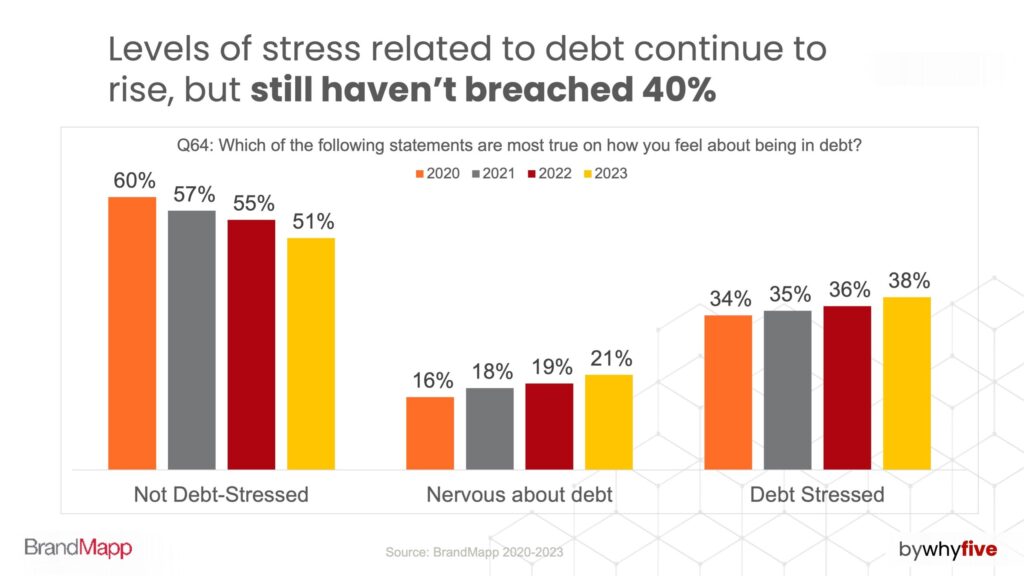
Debt stress levels among South Africa’s middle class have changed significantly over the past four years. The percentage of people saying they have no debts or are not worried about them has dropped from 60% to 51%, with the most substantial decline occurring in 2023. However, the situation isn’t entirely bleak. In the BrandMapp audience, fewer than 30% are classified as ‘debt-stressed,’ and in households earning R1 million or more annually, that figure drops to just 13%. Notably, 51% of all consumer-class adults are either debt-free or not concerned about their debts.
Age Matters
What Keeps South Africa’s Middle Class Awake at Night?
While financial concerns loom large, they are not the sole worry. According to BrandMapp, 47% of adults cite rising food and energy costs as their biggest stressor. 40% are concerned about weak economic growth, yet these financial worries rank below fears of crime and corruption.
Despite these concerns, resilience is evident. Almost 60% of South African middle-class adults report being the same or better off than they were two years ago, with only 15% saying they are much worse off. Encouragingly, high-income earners are growing at twice the rate of inflation, and the millionaire class (those earning R1 million+ annually) is expanding at an impressive 20%+ rate.
Shifting Spending Habits
Economic challenges are reshaping spending habits, but not uniformly. “At the lower end of the income spectrum, spending is focused on survival,” says De Kock. “However, higher-income consumers have more choice, meaning discretionary spending on luxuries like dining out or new cars is being postponed rather than abandoned.”
Aspirations remain steady, with 37% of adults wanting to buy or change their car this year and 22% looking to buy a house—only a slight drop from 28% three years ago. De Kock attributes this to younger income earners, or the ‘subscription generation,’ who view home loans as restrictive rather than an opportunity to climb the property ladder.
Attitudes Towards Wealth and Investment
In the face of economic uncertainty, South Africa’s middle class remains cautious about wealth-building. When surveyed on their investment attitudes, 28% describe themselves as ‘bold,’ while 41% are ‘conservative,’ and the remainder are uncertain. De Kock suggests this conservative approach reflects a ‘treading water’ mentality, especially among high-income groups who can afford to take a long-term perspective.
A Tale of Two Economies
South Africa’s financial landscape is increasingly polarized. De Kock explains, “We see a growing economic divide. On the one hand, 70% of the population lives below the tax-paying threshold, with limited financial choices. On the other hand, the middle-to-upper class, now around five to six million adults, is growing at the same rate as the struggling majority.”
He continues, “It’s a story of evolution rather than revolution. The data shows increasing consumer optimism, and we anticipate that the upcoming BrandMapp report will reveal another chapter with a hopeful ending.”
Latest BrandMapp Insights Now Available
BrandMapp insights are now available directly from the BrandMapp team at WhyFive Insights and via subscription through Telmar, Softcopy, Nielsen, and Eighty20.
For data access, email Julie-anne@whyfive.co.za or visit WhyFive for an overview of what’s in the latest report.